
Technical Architecture of Modern Iron Core Reactors: Mitigating Electromagnetic Degradation
In contemporary power electronic networks, non-linear loads generated by variable frequency drives (VFDs), active front-end converters, and renewable inverter stations introduce severe non-sinusoidal harmonic voltages. As an international CE Certified Iron Core Reactor Supplier & Exporter, our engineering framework solves the core physics limitation of magnetic saturation through distributed air-gap optimization.
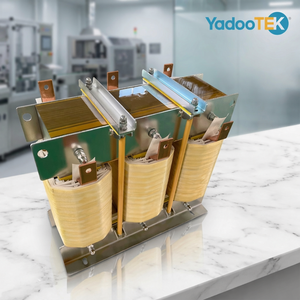
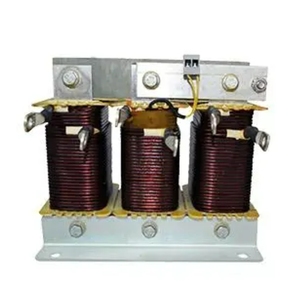
Unlike traditional solid-core inductor topologies that demonstrate catastrophic inductance roll-off under high short-circuit inrush conditions, gapped iron-core reactors utilize precision-machined, multi-stage air gaps interleaved with high-temperature electrical insulation laminates. This segmented approach subdivides the fringing flux field, suppressing localized eddy current hot spots within the copper conductor boundary layers and maintaining exceptional inductance linearity up to 200% of the nominal operational current.
Low-Loss Cold-Rolled Grain-Oriented (CRGO) Silicon Steel
Our magnetic cores are fabricated from prime-grade M3, M4, or high-permeability laser-scribed CRGO steel laminations. By aligning the rolling direction strictly with magnetic flux trajectories, our reactors achieve core loss ratings under 0.85 W/kg at 1.5 Tesla, keeping thermal dissipation significantly below conventional industrial averages.
Vacuum Pressure Impregnation (VPI) Class H/C System
To withstand extreme mechanical shock generated by short-circuit electrodynamic forces, core and coil assemblies undergo dual-cycle solventless epoxy resin Vacuum Pressure Impregnation. This guarantees void-free encapsulation, superior acoustic decibel dampening (<62 dBA at 1 meter), and reliable dielectric resilience up to Class H (180°C) and Class C (220°C).
Fringing Flux & High-Frequency Eddy Control
By engineering specialized edge-shielding and transposing rectangular copper windings with electrolytic Grade-A copper foil or nomex-wrapped multi-strand bundles, skin-effect and proximity-effect losses are mitigated across the 5th, 7th, 11th, and 13th harmonic spectra under continuous inverter PWM stress.
Enterprise Heritage & Infrastructure: The Engineering Edge
Drawing on an automation and power quality legacy established in 1990 by parent entity Prima Automation (India) Pvt. Ltd., Prima Transformers was founded in 2006 to focus exclusively on high-reliability magnetic equipment. Spanning over 5,500 square meters in Santej, Ahmedabad, our facility bridges the critical divide between pure component production and integrated system reliability.
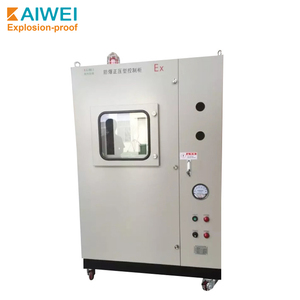
Because our operational origins lie in manufacturing mission-critical PC, PLC, and SCADA-based control panels—including explosion-proof, pressurized, and intrinsically safe systems for hazardous locations—we engineer iron core reactors not as isolated inductors, but as systemic defense nodes. We understand the precise balance required between primary leakage reactance, ambient heat rise inside sealed switchgear enclosures, and the corrosive conditions characteristic of metallurgy, mining, and chemical processing facilities worldwide.
| Engineering Attribute | Standard Commercial Reactor | Prima CE-Certified Iron Core Reactor | Operational Benefit |
|---|---|---|---|
| Magnetic Core Grade | Non-oriented silicon steel (0.50mm) | Laser-treated low-loss CRGO (0.23mm - 0.27mm) | Up to 42% lower iron losses, eliminating localized overheating |
| Inductance Linearity | Drops steeply at 130% - 150% Inom | Maintains >95% linearity up to 200% Inom | Prevents drive trips during utility voltage sags & heavy surges |
| Insulation Processing | Dip-and-bake conventional varnish | Automated Vacuum Pressure Impregnation (VPI) | Void-free dielectric strength, resistance to high-humidity salt mist |
| Thermal Class Rating | Class B (130°C) or Class F (155°C) | Class H (180°C) standard, Class C (220°C) optional | Exceptional thermal reserve in non-ventilated IP54 enclosures |
| In-House Routine QA | Basic multi-meter & megger checks | Computerized DVDF, LCR meter, milli-ohm & OC/SC test panel | 100% factory conformance with full traceable routine test certs |
Future Procurement & Technological Trends in Magnetic Components
The power quality sector is experiencing rapid transformation driven by three macroeconomic macro-forces: widespread deployment of wide bandgap (SiC and GaN) semiconductor switching systems, aggressive international efficiency mandates, and decentralized renewable energy infrastructure. Engineering and procurement heads must adapt selection criteria to accommodate these developments:
Higher Carrier Frequencies (dv/dt Management)
Modern silicon-carbide variable-speed drives operate at switching frequencies exceeding 16 kHz to 30 kHz. As pulse rise times sharpen (dv/dt exceeding 10 kV/μs), reflected wave voltage peaks at the motor terminals degrade stator winding insulation. Future-ready procurement focuses on high-frequency tuned iron-core load reactors and sine-wave filtering stages capable of withstanding severe inter-turn voltage gradients without insulation degradation.
Digital Twin & Condition Monitoring Integration
Procurement frameworks across tier-1 energy groups (such as Tata, Jindal, UltraTech, and ONGC) increasingly mandate integrated real-time sensory instrumentation. Embedding dual PT100/PT1000 platinum RTD sensors and fiber-optic thermal probes directly within central core air gaps enables SCADA systems to compute dynamic thermal degradation models, preventing unpredicted downtime.
Total Cost of Ownership (TCO) & Eco-Design Directives
Evaluating reactors merely by initial capital expenditure is obsolete. With global carbon border adjustments and strict utility penalization for total harmonic distortion (THD > 5% according to IEEE 519-2022 standards), purchasers evaluate lifecycle watts lost over 15 to 20-year service horizons. High-efficiency CRGO iron core reactors recover their capital cost premium within 18 months via reduced panel HVAC chiller requirements.
Engineering FAQ: Critical Considerations for Specifying Iron Core Reactors
What electrical parameter differences dictate choosing between a 3% and 5% impedance iron core line reactor?
A 3% impedance (%Z) reactor is typically deployed for basic supply transient absorption, notch reduction, and moderate drive input protection where grid short-circuit levels are standard. A 5% impedance iron core reactor is required where IEEE 519 compliance is mandated, reducing input total harmonic current distortion (THDi) from upwards of 80% down to approximately 30-35%. Furthermore, 5% reactors provide robust protection in facilities utilizing power factor correction capacitor banks, dampening resonance points and limiting incoming line surges that cause overvoltage DC-bus tripping on drives.
How does Prima verify core saturation limits during routine and type factory acceptance testing?
Our 5,500 m² Santej facility utilizes fully computerized open-circuit and short-circuit test benches, digital LCR meters, and Double Voltage Double Frequency (DVDF) induced overvoltage instrumentation. Linear saturation limits are confirmed by ramping current up to 150% and 200% of the continuous rated amperage while tracking incremental inductance variance (ΔL). Units pass factory acceptance only if inductance remains within 90-95% of nominal value at overcurrent thresholds, verifying zero magnetic collapse during line fault situations.
Why is acoustic noise control a major challenge in iron core reactors, and how is it suppressed?
Acoustic noise in iron core inductors originates from magnetostriction (microscopic dimensional changes in the core laminations under cyclic magnetic excitation) and Maxwell electromagnetic forces across the physical air gaps. Prima addresses this through four structural safeguards: high-compression non-magnetic clamping hardware, precision water-jet segmented core blocks, high-temperature ceramic or glass-cloth air-gap spacers, and dual-cycle vacuum pressure impregnation (VPI) using pure solventless epoxy resin that locks the entire core-coil structure into an acoustically dead monolith.
What specific technical data must procurement teams supply for an engineered-to-order reactor quotation?
To guarantee optimal electrical matching, share: (1) System operational voltage and network frequency (50 Hz or 60 Hz); (2) Rated fundamental current (Amperes) and motor/drive kW rating; (3) Required target impedance percentage (%Z) or absolute inductance value (mH); (4) Harmonic spectrum distribution profile (e.g., THDv, carrier frequency spectrum); (5) Thermal insulation class (Class H standard); (6) Environmental conditions including maximum ambient temperature, installation altitude, and IP enclosure rating (IP00 open core/coil up to IP66 outdoor rated enclosures).
How do iron core reactors contrast with air-core inductors in high-power industrial plants?
Air-core reactors exhibit complete magnetic linearity since they lack a saturable ferromagnetic medium. However, because air has low magnetic permeability, air-core units require significantly more turns, larger physical footprints, and substantial magnetic clearance perimeters to prevent electromagnetic induction into adjacent steel structures, panels, and rebar. Gapped iron-core reactors contain the magnetic flux within high-permeability grain-oriented steel circuits, enabling compact panel integration, minimal stray magnetic fields, and lower overall installation volume.
Connect Directly with Our Power Magnetics Engineering Team
Whether you require standard CE-marked VFD line/load reactors up to 2500A, customized DC smoothing chokes, or high-impedance harmonic mitigation units for harsh environments, our technical engineers provide comprehensive design verification and factory-direct pricing within 24 hours.
Contact Us