 CEMarked CEMarked
Engineered for high-frequency switching environments, automated plant floors, cleanrooms, and high-density industrial control panels requiring low electromagnetic radiation and robust thermal headroom.
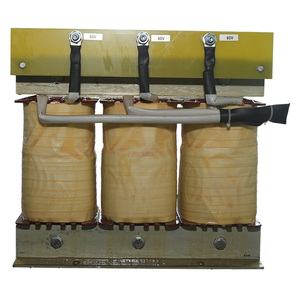
A rigorous engineering review of harmonic detuned reactors (分流リアクトル / 直列リアクトル) operating under METI guidelines, JIS C 4801 standards, and the unique 50Hz/60Hz split infrastructure of Japan.
Japan remains the only industrialized nation divided between 50Hz (Eastern Japan: TEPCO, Tohoku, Hokkaido) and 60Hz (Western Japan: KEPCO, Chubu, Kyushu). A standard 6% or 7% detuned reactor calibrated for 50Hz will shift its resonant frequency (fr) upwards if energized on a 60Hz bus, moving the resonance point directly into the critical 5th harmonic band (250Hz vs 300Hz). We manufacture dual-rated, laser-gapped magnetic cores calibrated explicitly for local utility requirements.
Power factor correction (PFC) capacitors connected without series reactors create a parallel resonant circuit with the upstream substation step-down transformer. When non-linear loads (such as variable frequency inverters, thyristor rectifiers, and servo systems) inject harmonic currents close to this resonance point, overvoltages and current amplification destroy capacitor dielectric film. Our series reactors introduce inductive impedance above the tuning frequency, permanently preventing parallel resonance.
Under heavy harmonic distortion (THDv > 8%, THDi > 30%), standard iron cores saturate magnetically, causing an abrupt drop in inductance (L). This drop shifts the tuning point upward, precipitating sudden system resonance. Prima detuned reactors employ low-loss, grain-oriented silicon steel (CRGO) with micro-gap spacers bonded with high-temperature epoxy, maintaining strict linearity exceeding 180% of rated nominal current even during maximum harmonic current absorption.
| Detuning Factor (p) | Resonant Freq. (50Hz Grid - Tokyo) | Resonant Freq. (60Hz Grid - Osaka/Nagoya) | Target Harmonics Mitigated | Primary Industrial Application |
|---|---|---|---|---|
| p = 7% (Xl/Xc = 0.07) | 189 Hz (Tuning Order 3.78) | 227 Hz (Tuning Order 3.78) | 5th (250/300Hz), 7th, 11th, 13th | Standard Industrial High-density automated automotive lines, CNC machining centers. Prevents 5th harmonic resonance. |
| p = 5.67% / 6% | 204 Hz / 210 Hz | 245 Hz / 252 Hz | High 5th harmonic absorption | Heavy Inverter Loads Semiconductor manufacturing tools, VFD-driven HVAC pump systems, cleanrooms. |
| p = 14% (Xl/Xc = 0.14) | 134 Hz (Tuning Order 2.67) | 160 Hz (Tuning Order 2.67) | 3rd (150/180Hz), 5th, 7th | High Neutral Distortions Commercial data centers, single-phase switching supplies, EV charging clusters, arc furnaces. |
Delivering high-reliability harmonic filtering reactors designed to withstand seismic vibrations, high ambient factory temperatures, and strict electromagnetic compliance requirements across prefectures.
With massive fab expansions across Kumamoto ("Silicon Island") and Sendai, photolithography, etching, and chemical vapor deposition (CVD) tools demand pure sinusoidal power without voltage notching. Our detuned reactors prevent capacitor bank tripping and eliminate harmonic distortion that can scramble sensitive wafer-handling robotics and yield telemetry.
Stamping lines, high-frequency resistance welding, and continuous multi-axis robotic welding cells generate extreme non-linear current spikes. We export custom 200V, 400V, and 440V detuned reactors engineered with Class H Nomex insulation systems to guarantee that power factor correction equipment performs continuously without thermal burnout.
Under METI guidelines for renewable grid connections, solar PV and battery energy storage stations (BESS) must curb high-order inverter harmonics before energizing utility transmission lines. Our heavy-duty line reactors and detuned filtering chokes damp switching ripples, ensuring total harmonic distortion (THD) complies with strict regional transmission codes.
Key regulatory and architectural shifts shaping how Japanese facility managers, trading companies (商社), and electrical engineering consultants procure harmonic mitigation equipment.
The Ministry of Economy, Trade and Industry (METI) enforces rigorous guidelines for calculating equivalent harmonic current injection per kVA of contract demand. Facilities exceeding limits face direct financial penalties and reconnection delays, mandating certified detuned reactor banks at every major substation node.
Japan's GX decarbonization agenda mandates reducing no-load losses in all magnetic elements. High-permeability, step-lap silicon steel cores engineered by Prima drastically lower iron and winding losses, lowering lifetime heat dissipation inside tightly enclosed Japanese switchgear panels.
The fast adoption of Silicon Carbide (SiC) and Gallium Nitride (GaN) power semiconductors in high-speed factory automation creates high dv/dt wavefronts. These fast transitions require output line reactors with high inter-turn insulation to prevent motor bearing destruction and insulation breakdown.
Equipment deployed in Tokyo, Kanagawa, Osaka, or Shizuoka must endure severe seismic shock factors without structural rupture. Our reactors feature reinforced base channels, vacuum pressure impregnated (VPI) coil consolidation, and vibration-proof terminal blocks conforming to strict JEAG seismic guidelines.
Every reactor and transformer exported to Japan is fabricated, assembled, and verified within our ISO-certified facilities under computer-automated test benches matching international and Japanese industrial standards.
Practical answers covering specifications, compliance with JIS/JEM regulations, trading company (商社) coordination, and international logistics for Japan-bound projects.
Yes. Because the resonance point shifts based on grid frequency (50Hz vs 60Hz), a reactor manufactured for Tokyo Electric Power (TEPCO - 50Hz) cannot be deployed in Kansai Electric Power (KEPCO - 60Hz) without recalculating the detuning factor. We design custom winding configurations and core gaps optimized precisely for the installation prefecture's nominal frequency, ensuring exact impedance ratios (p = 7%, 6%, or 14%) are preserved.
Our reactors are engineered and tested in accordance with JIS C 4801 (Power Capacitors and Series Reactors) and JEM-TR 177 standards. We verify temperature limits, withstand voltage, linearity factors under 1.8 × nominal current, and harmonic load capabilities through computerized testing benches, supplying fully documented Japanese/English test reports with each export shipment.
Yes. We regularly cooperate with international trading houses, EPC contractors, and OEM panel builders. We accommodate specific Japanese documentation demands, including Mill Test Certificates, Inspection Data Sheets (検査成績書), Non-Inclusion Certificates for chemical substances (RoHS/REACH), and fumigated export palletizing conforming strictly to Japan Customs standards.
Every detuned reactor coil phase is embedded with micro-thermal switches (normally closed, tripping at 120°C, 130°C, or 150°C based on customer insulation class specifications). These dry contacts can be wired directly into PLC control loops or MCCB shunt trips to protect capacitor banks if unexpected harmonic overload occurs in the facility.
Compact electrical rooms (キュービクル) in Japanese commercial buildings and urban facilities require strict noise control. We use precision laser-cut grain-oriented silicon steel (CRGO), segmented air gaps bonded with vibration-absorbing elastomeric resins, and complete dual-cycle vacuum pressure impregnation (VPI), guaranteeing operating noise levels well within municipal decibel thresholds (typically under 55 to 62 dBA at 1 meter).
Please specify: System operating voltage (e.g., 200V, 220V, 400V, 440V, or 6.6kV), grid frequency (50Hz or 60Hz), capacitor bank nominal rating (kvar), desired detuning factor (e.g., p = 7%, 6%, or 14%), ambient operating temperature, insulation class (Class F or H), and any specific physical dimensional boundaries for switchgear retrofits.
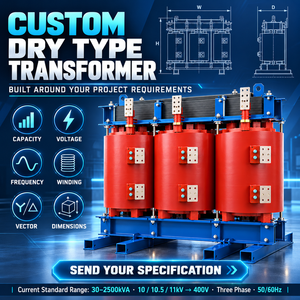
From custom 50/60Hz harmonic detuned reactors and output line chokes to dry-type distribution transformers up to 5000kVA, our electrical engineering team delivers guaranteed compliance, full testing documentation, and fast international dispatch.