 CEMarked CEMarked
Custom engineered power distribution centers, withdrawable motor control cubicles, and intelligent modular assemblies compliant with IEC 61439-1/2, GB 7251.1, and IEEE benchmarks.
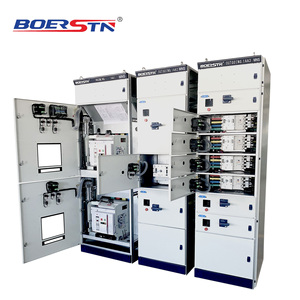
Standardized fixed-mount AC low-voltage distribution cabinet tailored for substations, industrial plants, and utility power distribution stations requiring high reliability.
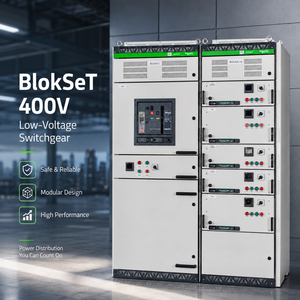
Engineered for extreme fault-level environments with high short-time withstand current, integrated arc containment barriers, and intelligent energy telemetry.
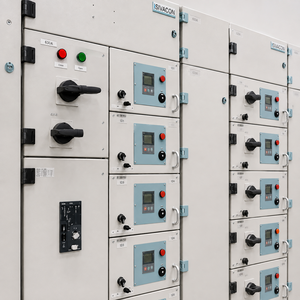
Modular industrial power switchboard built to Siemens 8PT structural profile standards, providing active arc-fault protection for primary distribution substations.
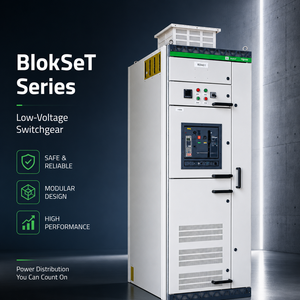
High-density selective power train panel featuring dual busway inputs, zero-downtime withdrawable cassettes, and harmonic mitigation for hyperscale computing.
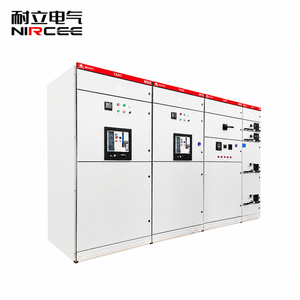
Fully withdrawable system utilizing C-shaped profile framework with 25mm modular pitch, delivering extreme mechanical stiffness, interchangeable drawer modules, and OEM flexibility.
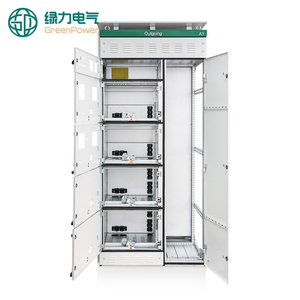
Dedicated continuous-process motor control center providing segregated functional units, high-enduring primary disconnect contacts, and smart soft-starter/VFD integration.
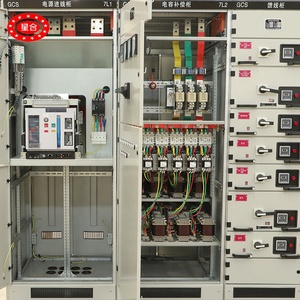
Economical and robust drawout switchboard design incorporating individual power center and motor control functional compartments for steel, petrochemical, and paper mills.
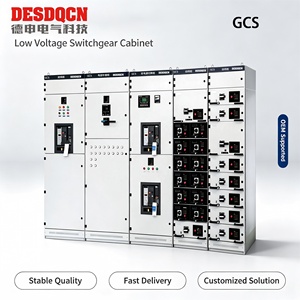
High-performance drawout distribution panel engineered with 20mm modular framing, offering high mechanical density, rapid component interchangeability, and low thermal rise.
Our electrical engineering team provides comprehensive design support including Single Line Diagrams (SLD), GA drawings, busbar thermal simulations, and third-party witnessed test documentation for global EPC tenders.
Technical evaluation of modernization vectors transforming low-voltage power distribution systems, functional safety compliance, and energy transition assets.
Modern LV assemblies have transitioned from passive circuit protection frames into active edge computing nodes. Next-generation installations embed wireless non-contact surface acoustic wave (SAW) temperature sensors directly onto primary busbar joints, incoming air circuit breaker (ACB) stabs, and cable terminations. Continuously streaming thermal data into on-door edge gateways allows predictive calculation of contact deterioration using machine learning thermal gradient algorithms, virtually eliminating catastrophic arc flare-ups resulting from micro-ohmic contact creep.
While passive segregation (Form 4b separation) protects adjacent functional cubicles, modern high-fault-level applications demand active containment. Modern switchboards incorporate point optical sensors coupled with pressure diaphragm switches across the busbar compartment. When an internal arc ignition occurs, high-speed fiber-optic detection circuits signal an ultrafast pyro-breaker or short-circuit grounding switch in under 4 milliseconds, extinguishing the plasma plume before destructive mechanical overpressure breaches the enclosure boundary.
With widespread integration of on-site distributed energy resources (DERs), battery energy storage systems (BESS), and regenerative loads, low-voltage switchgear must accommodate bidirectional power flows. Conventional unidirectional overcurrent trip curves (ANSI 51/50) are being replaced by digital multifunction protection relays featuring directional overcurrent (67), rate-of-change-of-frequency (ROCOF 81R), and programmable logic interlocking to safely ride through grid-tied and islanded mode transitions without false tripping.
Benchmark comparison across international industrial switchgear configurations to guide electrical consultants and procurement officers in system selection.
| Characteristic / Metric | MNS Modular Architecture | GCS Withdrawable Series | GCK Drawout Platform | GGD Fixed-Mount Cabinet |
|---|---|---|---|---|
| Structural Standard | C-profile 25mm modular pitch | KS-profile 20mm modular pitch | FA profile 20mm/25mm framework | 8MF profile welded / bolted frame |
| Max. Rated Current (In) | Up to 6300A (Main Busbar) | Up to 4000A (Main Busbar) | Up to 3150A (Main Busbar) | Up to 3150A (Main Busbar) |
| Rated Short-Time Withstand (Icw) | 80kA / 100kA / 150kA (1s) | 50kA / 80kA (1s) | 50kA / 65kA (1s) | 30kA / 50kA (1s) |
| Internal Segregation Form | Form 3b, Form 4a, Form 4b | Form 3b, Form 4a | Form 3a, Form 3b | Form 1, Form 2b |
| Drawer Interlocking Mechanism | 3-position (Connected/Test/Drawout) with padlocking | 3-position mechanical rotation interlock | Lever-operated multi-point interlocking | Door-coupled breaker handle defeat mechanism |
| Maintenance & Downtime | Ultra-low (hot-swappable drawer replacement < 3 mins) | Low (rapid drawer changeout) | Moderate (drawout module disconnection) | Standard (requires de-energization or live work protocol) |
| Primary Target Application | Offshore, nuclear, petrochem, Tier IV data centers | Continuous manufacturing, energy utilities, water plants | Light chemical, commercial hubs, metal smelting | Secondary distribution, workshops, infrastructure pumping |
Key risk-mitigation vectors, sustainability metrics, and supply chain protocols shaping modern switchgear acquisition programs.
Global procurement teams are shifting away from upfront capital cost evaluation toward lifecycle calculations. Switchboards engineered with superior busbar electroplating (minimum 12µm tin or 5µm silver on high-conductivity E-Cu), finite-element-analyzed thermal chimneys, and Form 4b internal segregation drastically diminish scheduled preventative maintenance shutdowns. Reduced mean-time-to-repair (MTTR) and extended MTBF produce up to a 34% reduction in twenty-year operating expenditures across critical continuous-process plants.
Supply chain bottlenecks in proprietary electronic trip units and OEM breakers have driven international EPC contractors toward non-proprietary switchgear enclosure platforms. By standardizing on modular skeletons (such as 25mm universal grid frameworks) that accommodate circuit breaker components from multiple major tier-one manufacturers (e.g., Schneider Electric, ABB, Siemens, Chint, and LS), engineering contractors safeguard their delivery milestones against single-source component lead times.
Tier-1 utilities and consulting engineering authorities are rejecting self-certified compliance declarations. Procurement mandates now demand third-party witnessed type-test certificates from accredited international bodies (ASTA, KEMA, CESI, or TUV) covering temperature-rise limits, short-circuit withstand, dielectric properties, and internal arc classification. Furthermore, end-users expect digital asset passports featuring individual serialized FAT dossiers, mill test certificates for structural steel and copper, and cloud-accessible calibration records.
Combining over two decades of electrical power manufacturing, specialized panel automation experience, and industrial testing facilities.
Backed by our corporate heritage in PC, PLC, and SCADA-based control panels, flameproof pressurized systems, and hazardous-area automation, we design switchgear from the perspective of real-world control integration.
Our expansive production facility houses CNC laser cutting, automated punching, precision CNC bending, busbar electroplating, assembly lines, and specialized testing laboratories under one controlled environment.
Every switchgear unit undergoes routine inspection: computerized open/short circuit routines, high-voltage dielectric verification, contact resistance testing (milli-ohm range), and primary/secondary injection tests.
Supplying major multinational conglomerates and EPC projects across the globe in heavy mining, steel manufacturing, cement processing, petrochemical facilities, and hyperscale data centers.
Clear, technical explanations to the most common questions raised by electrical consultants, EPC contractors, and plant engineers.
Under IEC 61439-2, both forms require separation of the main busbars from functional units, and separation of all functional units from each other. The core difference lies in the termination points: in Form 3b, the cable terminals for external conductors are not separated from one another, whereas Form 4b mandates that the terminals for external conductors associated with an individual functional unit must be completely compartmentalized from the terminals of any other unit. Form 4b allows technicians to safely cable or terminate an unpowered drawer while adjacent circuits remain live and energized.
Standard ratings assume an ambient temperature of 35°C (24h average) and an altitude below 1000m above sea level. Above 35°C, busbar cross-sections and circuit breaker nominal ratings must be adjusted according to IEC manufacturer derating curves (typically a factor of 0.95 at 45°C and 0.88 at 55°C). For installations above 1000m, reduced air density impairs both heat dissipation and dielectric insulation strength. For elevations up to 2000m-3000m, clearance distances are increased, dielectric test voltages are scaled, and forced ventilation or wider modular spacing is engineered to maintain permissible component temperature limits.
Yes. Our engineering production facility operates as an agile, vendor-independent OEM builder. Our modular framing designs (incorporating both 20mm and 25mm hole pitch frameworks) feature standardized mounting plates and primary disconnect stabs compatible with major worldwide circuit breaker manufacturers, including ABB (Emax/Tmax), Schneider Electric (MasterPact MTZ/Compact NSX), Siemens (Sentron 3WL/3VA), Eaton, and Chint. We supply completely verified type-tested integration solutions matching your plant's spare parts standardization policies.
Prior to export packaging, each low voltage lineup undergoes rigorous Factory Acceptance Testing (FAT). Documentation supplied in our technical project handover binder includes: comprehensive routine test certificates (dielectric test at 2500V, insulation resistance, contact resistance measurement), functional verification checklists of control schemes, as-built Single Line Diagrams (SLD), general arrangement and foundation drawings, busbar torque check documentation, CE Declaration of Conformity, third-party type-test summaries, and comprehensive operation and maintenance manuals.
From standard GGD cabinets to high-density MNS/GCS drawout motor control centers, our engineering teams provide end-to-end design, manufacturing, and export-compliant delivery tailored to your project schedule.