
Technical White Paper: OEM Engineering Specifications for Grounding Transformers
Grounding transformers (Neutral Grounding Compensators) serve as an indispensable component in three-phase electrical distribution networks where ungrounded (Delta-connected) architectures or ungrounded Wye generators require a stable, artificial neutral point. Without a designated zero-sequence return pathway, ungrounded industrial networks run the critical hazard of transient overvoltages triggered by arcing ground faults—voltages that frequently spike up to 300% to 500% of nominal system line-to-neutral levels, devastating phase insulation and leading to multi-phase flashovers.
As premier custom OEM grounding transformer manufacturers and tier-one factories, our engineering methodology bridges electromagnetic design with operational durability. Grounding transformers are built primarily in two distinct topological profiles: the Zig-Zag (ZNyn or ZN) interconnected star design and the Wye-Delta (Ynd) configuration. The zig-zag winding topology is predominantly favored by switchgear OEMs and substation procurement teams because it provides an inherently low zero-sequence impedance (Z₀) path to fault currents while concurrently exhibiting exceptionally high magnetizing impedance (Z₁) to standard positive- and negative-sequence operational currents. This ensures negligible idle no-load losses during continuous system operation.
Electromagnetic Topology: Zig-Zag (ZN) vs. Wye-Delta (Yd)
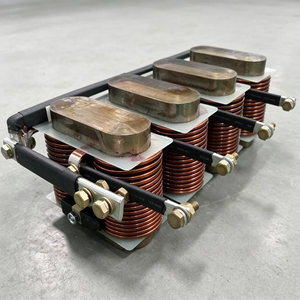
In a standard Zig-Zag arrangement, each magnetic limb holds two physically identical winding segments wound in opposing phase relationships. When normal symmetrical positive- or negative-sequence three-phase currents pass through the core, the magnetic fluxes generated by the two halves of the winding on each limb cancel out symmetrically, presenting an effective open-circuit magnetizing impedance. Conversely, during a line-to-ground fault on any phase, zero-sequence current splits uniformly across the phases: because the currents on each core leg flow in reverse directions through the interconnected coils, the ampere-turns neutralize each other, yielding minimal counter-electromotive force and restricting impedance solely to the leakage reactance and DC winding resistance. This mechanical-electrical property allows protection relays to instantly localize and isolate single-phase-to-ground faults.
| Engineering Parameter | Cast Resin Dry-Type Grounding Unit | Oil-Immersed (ONAN/KNAN) Grounding Unit |
|---|---|---|
| Nominal System Voltage | Up to 36 kV (BIL up to 170 kV) | Up to 150 kV (BIL up to 650 kV) |
| Vector Configuration | ZN, ZNyn11, Ynd1, Ynd11 | ZN, ZNyn11, Ynd1, Ynd11 |
| Short-Time Current Duration | 10 sec, 30 sec, 60 sec (Std. IEEE C62.92.4) | 10 sec, 30 sec, 60 sec, continuous ratings |
| Insulation Class | Class F (155°C) or Class H (180°C) | Class A Mineral Oil or Synthetic Ester (K-Class) |
| Zero-Sequence Impedance (Z₀) | Custom matched (Typically 1.5Ω to 50Ω/phase) | Custom matched per system fault level limits |
| Harmonic Tolerance | K-Factor up to K-20 with electrostatic shields | Designed for high THD inverter collector buses |
| Enclosure Protection | IP23 to IP54 for indoor/outdoor enclosures | Sealed tank, corrugated fin / radiator bank |
Future Sourcing Trends for Substation & Industrial Magnetics (2025–2035)
The global transition toward non-fossil distributed generation has radically altered procurement requirements for original equipment manufacturers (OEMs), engineering procurement construction (EPC) contractors, and industrial plants. Forward-looking procurement directors must take note of key structural shifts driving grounding transformer sourcing:
- Rise of Large Utility Solar PV & BESS Integration: Modern utility-scale solar photovoltaic arrays and Battery Energy Storage Systems (BESS) are paired with medium-voltage (MV) inverter transformers featuring delta-configured windings on the collector side. Grounding transformers are mandate-specified across wind and solar collector substations to anchor the system neutral, control ferroresonance, and limit neutral shift over long underground cable runs.
- Dry-Type Cast Resin Preference in Eco-Sensitive Areas: Environmental compliance standards (such as EU Ecodesign, US EPA Tier-4, and clean water preservation zones) are pushing industrial hubs away from mineral-oil units. Vacuum Pressure Impregnated (VPI) and epoxy cast resin dry-type grounding units eliminate fire hazards and hazardous fluid spill mitigation infrastructure.
- Integration of Auxiliary Continuous LV Windings: Instead of dedicating floor area to both a grounding bank and an auxiliary power transformer, EPCs now systematically request hybrid grounding transformers with an integrated auxiliary low-voltage winding (e.g., 400V/230V or 480V/277V). This allows a single magnetic footprint to deliver station service power for switchgear controls, SCADA, battery chargers, and perimeter illumination alongside fault grounding.
- Thermal Cycling Endurance and Dynamic Inrush Modeling: Grid-connected intermittent power profiles demand finite element analysis (FEA) testing for dynamic mechanical stress under repeated ground fault scenarios. Procurement teams reject standard generic catalog builds in favor of customized electro-mechanical blueprints verified through double-voltage double-frequency (DVDF) and dynamic short-circuit thermal modeling.
Manufacturing Integrity: The Engineering Edge
At our 5,500 m² modern manufacturing plant in Santej, Ahmedabad, our team draws on more than 25 years of parent company automation and power engineering expertise (Prima Automation heritage dating back to 1990). Controlling control panel architecture, flameproof enclosures, and high-voltage magnetics ensures our custom OEM grounding units fit directly into global switchgear lineups without field retrofitting. We conduct stringent routine quality verifications on every shipped unit—from computerized open-circuit/short-circuit parameters and insulation resistance testing to precise milli-ohm digital resistance evaluations and DVDF induced overvoltage verification.